
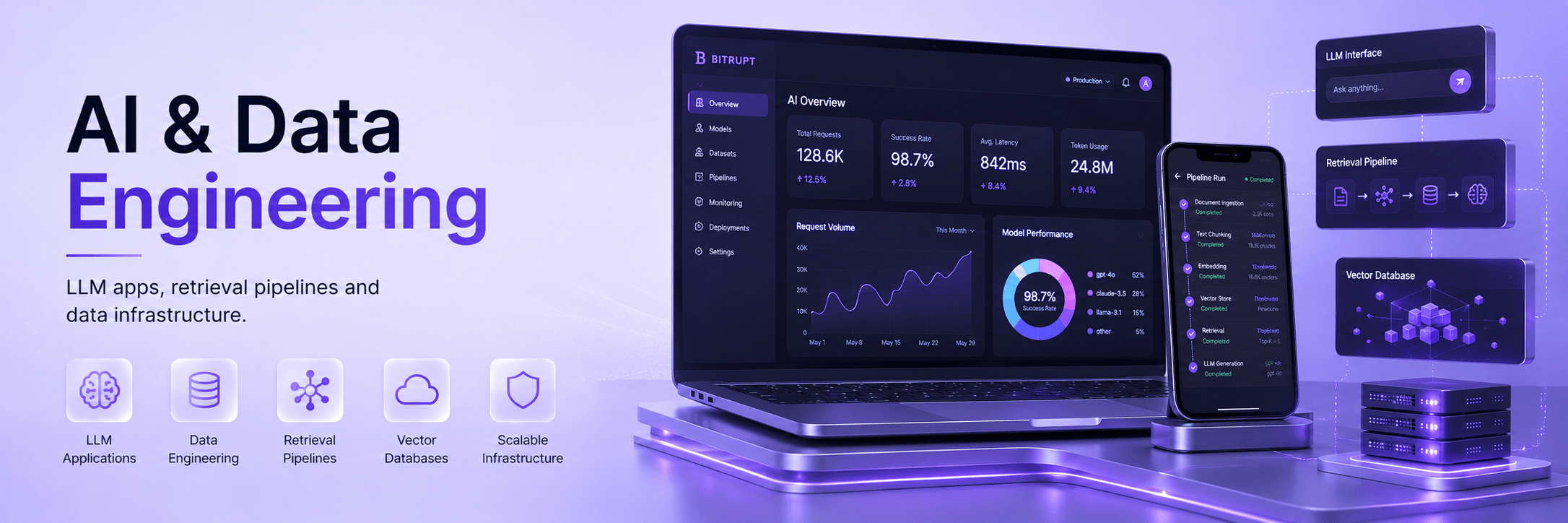
AI Development Services That Help Your Business Think Smarter.
Bitrupt is a top AI development company trusted by enterprises across the USA. We help businesses build smart apps, automate tasks, and make better decisions with data, combining custom AI solutions, generative AI, and machine learning into tools your team will use.
Why Businesses Need AI Development Services Today
Most businesses start with a ready-made CRM because it's fast to set up and cheap to try. The trouble tends to show up about a year in. Sales reps work around rigid fields instead of within them. Customer data lives in three tools that don't talk to each other. Pulling a simple report eats an afternoon instead of taking a click.
The Challenges
07Eat up time that could go toward higher-value work.
Scattered across different tools and systems, making the full picture hard to see.
Slower, less confident calls caused by unclear insights.
Repetitive, everyday tasks still done by hand.
Systems that can't keep up as the business grows.
New AI tools that don't connect well with old software.
Too many options, with no easy way to know which one fits.
Solution
This is where Bitrupt comes in. We are an artificial intelligence development company built for real business needs, starting every project with a clear AI strategy before writing any code. Our team builds custom AI software and applies machine learning where it adds real value, while our generative AI tools solve specific business problems. We use intelligent automation to handle repetitive tasks and free up your team for higher-value work. Every solution is built on a scalable AI architecture, so your systems can grow as your business grows, and we handle integration so new tools fit smoothly into what you already have.
Our Award-Winning AI Software Development Services
Bitrupt offers full AI development services, from early strategy through long-term support. Each service solves a real business problem. We do not just chase new technology for its own sake.
AI Consulting and Strategy
We study your business, data, and goals. Then we map out a clear AI plan that fits your budget and timeline.
Learn moreReady to Build Your AI Advantage.
Let's turn your ideas into AI tools that actually work for your business. Whether you need a custom AI solution, a generative AI application, or full-scale automation, our expert team is ready to help you build, launch, and grow together. Get in touch today!
Business Benefits of Hiring an AI Development Company

AI works best alongside your team, not in place of it. The goal is better tools for your people, not a replacement for their skill and judgment.
Our AI Software Development Process
We follow a clear, structured process for every AI project. It runs from the first conversation to long-term support.
Discovery
We learn about your business goals, current processes, and pain points.
AI Readiness Assessment
We review your data, systems, and team. This shows us what is realistic and where the best chances lie.
Solution Architecture
We design a scalable AI architecture and pick the right models and tools for your case.
Prototyping
We build a working prototype so you can see and test the idea early, before full development starts.
Development and Testing
Our engineers build the full solution and test it for accuracy, security, and speed.
Integration and Deployment
We connect the AI solution to your existing systems. We deploy it with as little disruption as possible.
Monitoring and Optimization
After launch, we track performance, retrain models when needed, and look for ways to improve results. At every stage, we follow responsible AI practices. We keep security and data privacy in mind, and we communicate clearly so you always know where your project stands.
FAQs
What do AI development services include?
How much does AI development cost?
How long does an AI project take?
What is generative AI, and how can it help my business?
Do I need clean data before starting an AI project?
How is AI security and data privacy handled?
Will AI replace my employees?
Can you integrate AI with our existing software?
Why should businesses choose Bitrupt as their AI development partner?
Web Platforms
The platforms that need this infra most — and benefit most from doing it well.
ExploreAI & Data Engineering
GPU workloads, vector DBs and the AI-specific ops nobody warned you about.
ExploreQuality Engineering
Test-in-CI infrastructure so release gates are real, not theatrical.
Explore