
AI-built code, made production-ready.
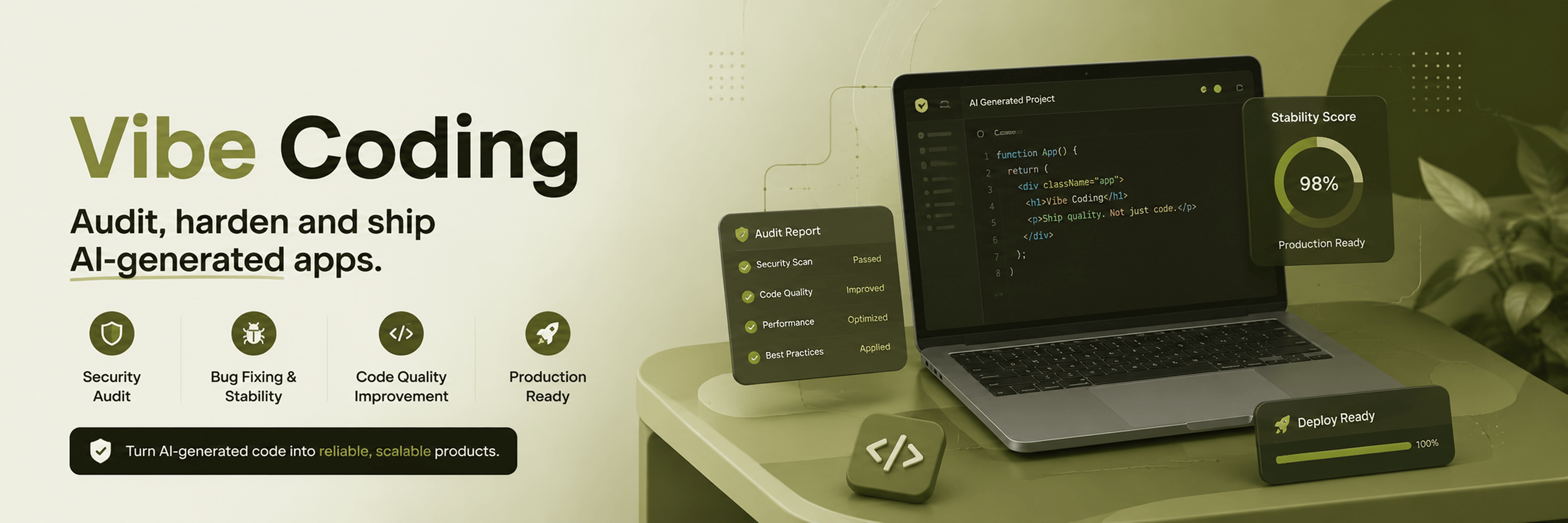
You shipped a prototype with Cursor, Claude or Copilot. It kind of works — but you wouldn't put it in front of real users. We audit, fix, secure and deploy AI-generated apps. Average time to production: two weeks.
Got an AI prototype nearly ready? Let’s audit the repo.
LLMs are great at getting something working. They’re not great at making it secure, tested or maintainable.
Vibe-coded prototypes carry the patterns of a tool that doesn’t know your stack or your stakes — hardcoded secrets, missing auth checks, N+1 queries, no tests. We read the whole codebase, write a prioritised audit, then work through the critical and high-severity items with you — auth, data access, security-critical paths first. The prototype keeps its momentum; your users keep their data.
Our Trustworthy Process to Vibe Coding
Our process for custom CRM development services starts with understanding your business, not writing code. Our crm developers map customer journeys, sales workflows, and technical requirements first, so every decision is grounded in how your team actually operates.
Audit the codebase
Inside 48 hours, every file is read. You get a prioritised report — security holes, anti-patterns, hardcoded secrets and missing error handling — with severity, file path and a fix sketch.
Fix and harden
We work top-down: auth flows, database access, the OWASP top-ten, the performance N+1s. You review the diff after each batch, and we don’t move on until you’ve signed off.
Wire the engineering loop
GitHub Actions, preview environments, linting, automated tests on the critical paths. The pipeline you’d have built first — retrofitted properly, in your accounts.
Ship to production
Vercel, AWS or GCP — environment configs, monitoring, error tracking and a runbook. The AI prototype becomes a real product, with the operational story behind it.
FAQs
What AI tools have you rescued code from?
How bad does the code need to be to qualify?
Will you rewrite everything?
What do I need to provide?
Quality Engineering
Once it’s stable, layer in the test pyramid and release gates that keep it stable.
ExploreCloud & DevOps
Production infra, observability and the on-call rotation behind the deploy.
ExploreAI & Data Engineering
If the AI is the product — not just the IDE — evals, retrieval and guardrails take over.
Explore