What Is Blockchain? Applications That Work in Practice
What Is Blockchain? Applications That Work in Practice !
Blockchain is a decentralized, tamper-resistant digital ledger: a shared record of transactions kept by many computers instead of one company, bank or government. NIST describes it as a way for a community of participants to maintain a shared, tamper-evident ledger. That one idea explains nearly every serious entry on the list of blockchain applications, from cross-border payments to drug tracking.
This guide is for beginners and for business leaders deciding whether the technology belongs in their product. We cover how it works, the three main types, where it is used today, and, just as important, where it is not worth the trouble.
BitruptBuild the Right Blockchain SolutionBitrupt builds custom software for fintech and other sectors, helping teams assess and develop secure, scalable platforms tailored to their needs.Explore Bitrupt’s software services
TL;DR
- Blockchain is a shared ledger where records are grouped into linked blocks, verified by a network, and very hard to alter afterward.
- The best-known blockchain applications sit in finance, supply chain, healthcare, voting and digital identity, but many projects never leave the pilot stage.
- Public, private and consortium chains trade openness for control and speed, so the type you choose matters as much as the idea.
- Scalability, regulation, energy use and interoperability are the real hurdles. A regular database is often the better answer.
- Before building, test the workflow first. If a trusted party can run it, you probably do not need a chain.
Table of Contents
- Blockchain in plain language
- How blockchain works
- Key features: transparency, security, immutability
- The types of blockchain
- Blockchain applications by industry
- Benefits of blockchain
- Challenges and limits
- Do you actually need a blockchain?
- Our perspective
- Future trends
- Working with Bitrupt
- Where to go next with blockchain
- FAQ
- Sources
Blockchain in plain language
Picture a notebook that every member of a club holds a copy of. When someone adds a line, everyone checks it against their own copy. If one person secretly rewrites an old page, the other copies disagree and the change is rejected. No single keeper has to be trusted.
That is the heart of blockchain. The U.S. Government Accountability Office explains that it combines several technologies to give a tamper-resistant record of transactions between parties without a central authority, such as a bank. Cryptocurrency is the best-known use, but it is only one of many.
How blockchain works
Four building blocks do the work. Understanding them makes every use case easier to judge.
Blocks and the chain
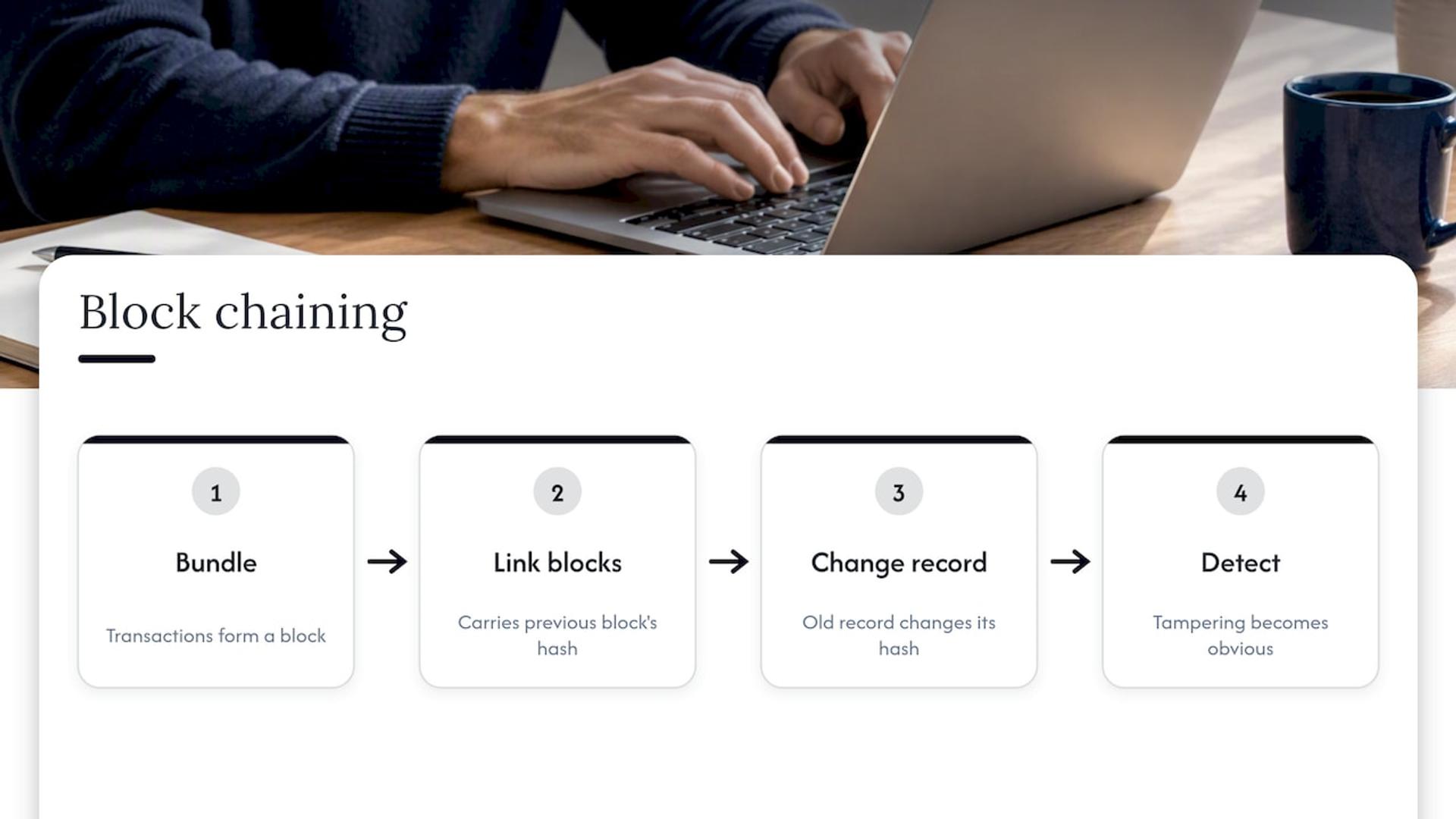
Transactions are bundled into a block. Each block carries a cryptographic fingerprint (a hash) of the block before it. Change one old record and its fingerprint changes, which breaks every block that follows. That chaining is what makes tampering obvious. NIST notes that the technology relies on cryptographic hash functions and distributed consensus to secure data.
Nodes
Nodes are the computers that hold a copy of the ledger and check new entries. The more independent nodes there are, the harder it is for any one party to cheat, and the fewer single points of failure you have.
Consensus
Consensus is the rule set the nodes use to agree on what gets added next. The two best-known methods are:
- Proof of work: nodes compete to solve a computational puzzle. It is secure but energy hungry.
- Proof of stake: participants lock up assets as a deposit and are chosen to validate blocks. It uses far less energy.
Smart contracts
A smart contract is code stored on the chain that runs exactly as written when set conditions are met. A payment can release automatically when a delivery is confirmed, for example. The Ethereum developer documentation describes how these contracts combine with a user interface to form decentralized applications.
There is a catch. Once deployed, a smart contract generally cannot be patched, so a logic error stays live. That is why testing and security audits come before launch, not after.
Key features: transparency, security, immutability
- Transparency: participants can see the same data. On public chains anyone can; on private ones, approved members can.
- Security: data is protected by cryptography and spread over many nodes, so there is no single database to breach.
- Immutability: records are extremely hard to change once confirmed. Corrections are made by adding new entries, not by erasing old ones.
Immutability cuts both ways. It is excellent for audit trails and a problem for data you may legally need to correct or delete, such as personal records. Keep that in mind when we reach healthcare and identity.
The types of blockchain
| Type | Who can join | Typical strength | Typical trade-off |
|---|---|---|---|
| Public | Anyone | Open, highly decentralized | Slower, higher cost per transaction |
| Private | One organization approves members | Fast, controlled, easier to keep confidential | Less decentralized, more trust in the owner |
| Consortium | A group of organizations | Shared governance between partners | Needs agreement among members |
A public chain suits open networks such as digital assets. A private chain suits one company that wants an internal audit trail. A consortium chain fits an industry group, say a set of banks or hospitals, that needs a shared record without handing control to one member.
If your system only involves a few parties who already trust each other, a secure and well-run conventional hosting setup with sound security practices may serve you better than any chain. We come back to that below.
Blockchain applications by industry
Here are the blockchain applications that get the most attention, with a realistic view of each.
Finance and payments
Finance is the most mature area. Uses include cross-border payments, tokenized assets and digital currencies issued by central banks. The Bank for International Settlements has written about tokenization, where traditional assets are represented digitally on programmable platforms. Its value lies in automating multi-step transactions with smart contracts, which can raise speed and transparency in high-value payments.
The GAO also points out that markets such as housing and commercial goods rely on intermediaries that blockchain could, in principle, make less necessary.
For teams building regulated products, the chain is rarely the hard part. Identity checks and compliance are. Our write-up on KYC and AML integration covers that side, and our fintech practice works on payments and wealth platforms.
Supply chain
Supply chains involve many companies that do not share a database. A shared ledger can record where a product came from and who handled it. The GAO lists tracing product provenance and sustainability among the uses. In pharma, a peer-reviewed review in PMC describes using chains for drug and medical device tracking to support recalls and help prevent counterfeits.
The weak spot is the point where the physical world meets the ledger. A chain can prove a record was not changed. It cannot prove the first entry was true, so sensors, scanning and process discipline still matter.

Healthcare
Healthcare is attractive because patient data sits in many separate systems. Experts cited by NIST say blockchain-based approaches could shift control of data toward the individual and reduce single points of failure, while still needing to fit existing health IT standards. The GAO has also noted that a digital health credential can address concerns about the security and ownership of personal health information, with blockchain as one example technology.
Two cautions apply. First, patient records fall under HIPAA, so any design needs privacy review, and sensitive data is usually kept off-chain with only references or proofs on it. Second, the immutability issue above is real when records must be corrected. If you are weighing patient-facing tools, this checklist on what to verify in HIPAA-compliant clinic check-in shows the kind of questions to ask of any system that touches sensitive information.
Voting
Voting is the most debated use. The appeal is a tamper-evident record of ballots. The risk is that elections demand ballot secrecy, accessibility, voter authentication and trust from people who are not technical. A ledger solves only a small part of that list. For now, treat voting as an area of experiments and pilots, not a settled application.
Digital identity and credentials
Identity may be the most natural fit. Today, your credentials sit with whoever issued them, and each login repeats the problem. With a chain-based approach, you hold a credential and share only what is needed. NIST has a taxonomy of blockchain identity systems that lays out the design choices. The Cybersecurity and Infrastructure Security Agency’s Public Venue Credentialing Guide from July 2026 covers credentialing for venues, a related problem where tamper-evident records matter.
Public services
Governments are testing blockchain for record keeping. The GAO has looked at whether the Small Business Administration could work more efficiently with blockchain, which shows how agencies are weighing the technology case by case.
Benefits of blockchain
- A shared source of truth for parties who do not fully trust each other.
- Audit trails that are hard to alter, which helps with compliance and disputes.
- Fewer intermediaries in some workflows, which can cut steps and delay.
- Automation through smart contracts that execute agreed rules.
- Resilience, because there is no single central database to fail or be attacked.
These benefits appear only when the problem fits. A shared ledger is worth little when one company already controls the whole process.
Challenges and limits
The GAO’s review of the technology lists the main hurdles, and they match what we see in practice.
Scalability
Many networks process far fewer transactions per second than a payment processor or a standard database. Design choices such as private chains or off-chain processing help, but they add complexity.
Regulation
Rules differ by use. Securities law, money transmission rules, privacy law and healthcare law may all apply to one product. Plan legal review early, with counsel who knows your sector.
Energy use
Proof-of-work networks use a lot of electricity. Proof of stake changed the picture: Ethereum’s switch in September 2022 reportedly cut its energy use by about 99.95%. Energy is therefore a question of which consensus method you choose, not of blockchain as a whole.
Interoperability
Most chains are isolated from one another and from legacy systems. Connecting them needs custom middleware or bridges, and that cost is easy to underestimate. The GAO also flags that many projects stay in the pilot stage because they fail to beat a traditional database at the core problem.
Security and skills
Decentralization introduces new threats. The National Security Telecommunications Advisory Committee, in a report to the President, stresses a rigorous risk assessment before adopting it in critical infrastructure. Skilled talent is also scarce, which is why a code review of any smart contract is not optional.
Do you actually need a blockchain?
Run this short test before spending a dollar.
- Do multiple parties write to the same record? If only you do, use a database.
- Do those parties lack a trusted intermediary? If a trusted party can run it, a central system is cheaper and faster.
- Does tamper evidence matter more than speed and flexibility? If you need quick edits and deletions, think twice.
- Can you connect it to the systems you already run? Budget for integration from day one.
- Can you pass a regulatory review? Check the rules that cover your data and your customers.
If you answer no to the first two, the GAO’s own caution applies: for many business needs, a conventional database is simpler. This is the same discipline we preach about any build. Analysis is cheap insurance, and skipping it is how a project ends up as a Ferrari bought for a farm. Our guide to the development phases leaders must enforce walks through that early work.
Our perspective
We build software for healthcare, fintech, marketplaces, AI and ed-tech teams, and the question we hear is rarely “how do we use blockchain?” It is “how do we solve this trust or data problem?” Sometimes the honest answer is a well-designed database with strong access controls, an audit log and a clean API. Sometimes it is a shared ledger.
What we do insist on is the same in both cases. Senior engineers should scope the problem, the integration points and the failure modes before the first line of code. Smart contracts, in particular, deserve the strictest testing you can afford, because they cannot be hot-fixed. Test automation, security review and API contract checks are not extras here. Our article on API contract testing shows how we catch integration breakage early, and that matters doubly when a chain talks to legacy systems.
If we advise against a chain for your project, it is because we would rather you ship something that works. If we advise for one, we will tell you what it costs to integrate and maintain.
— Usama
Future trends
Nobody can promise where the market lands, but several directions show up in credible sources:
- Tokenization of financial assets, as covered by the BIS, moving from experiments toward programmable settlement.
- User-controlled identity and credentials, where individuals decide who sees their data.
- More energy-efficient consensus, shifting away from proof of work.
- Interoperability work, since isolated chains limit value.
- AI alongside ledgers, with AI systems drawing on verifiable data and ledgers recording model or data provenance. This is still early, so treat claims with caution.
The pattern is steady: the technology advances where the problem is truly about shared trust, and stalls where a simpler system would do.
Working with Bitrupt
If you are deciding whether blockchain belongs in a fintech, healthcare or marketplace product, we can help you test the idea first and then build what fits. Our team of senior engineers covers web platforms, mobile apps, enterprise software and AI and data, and we offer flexible models such as development pods and staff augmentation. Tell us what you are trying to solve and we will respond within 24 hours, starting from bitrupt.co.
Where to go next with blockchain
Blockchain applications are strongest where several parties need one trusted record and no one wants to hand control to a single owner. They are weakest where a database would do the job. Start with the problem, read the primary sources, and prototype small before you commit.
To keep exploring, read the NIST and GAO pages linked above, pick one industry that matches your work, and sketch the workflow on paper. If it still needs a shared ledger after that, you have found a real candidate. When you are ready to turn it into a product, we are happy to talk.
FAQ
What are some examples of blockchain applications?
Common examples include cross-border payments and tokenized assets in finance, provenance tracking in supply chains, drug and device tracking in healthcare, and digital credentials for identity. Governments also test it for record keeping. Many of these are still pilots rather than everyday systems.
What are the four types of blockchain?
Most guides name three main types: public, private and consortium. Some add a fourth, hybrid, which combines public and private features so that part of the data is open and part is restricted. Which one fits depends on who needs access and who must be trusted.
Is blockchain the same as Bitcoin?
No. Bitcoin is one cryptocurrency that runs on a blockchain. Blockchain is the underlying ledger technology, which, as NIST notes, underlies many cryptocurrency systems but can be used in other ways too.
Is blockchain really unhackable?
No. The ledger is hard to alter, but the software around it, such as smart contracts, wallets and bridges, can have flaws. Because smart contracts generally cannot be patched after launch, testing and independent security audits before deployment are essential.
Does blockchain use a lot of energy?
It depends on the consensus method. Proof-of-work networks use a lot, while proof-of-stake networks use far less. Ethereum’s 2022 move to proof of stake is the best-known example of that change.
Sources
- NIST: Blockchain
- U.S. GAO: Blockchain, Emerging Technology Offers Benefits for Some Applications but Faces Challenges
- U.S. GAO: Blockchain, Financial and Non-Financial Uses and Challenges
- U.S. GAO: Small Business Administration, Exploring Potential Use of Blockchain
- U.S. GAO: Science & Tech Spotlight, Digital Vaccine Credentials
- ethereum.org: Technical introduction to dapps
- BIS: Leveraging tokenisation in payments and financial transactions
- NIST: A taxonomic approach to blockchain identity management systems
- CISA: Public Venue Credentialing Guide
- NSTAC report to the President on emerging technologies
- PMC: Blockchain applications for the healthcare sector
- CoinTracker: What is the Merge?