Quality Assurance: A Critical Ingredient for Organizational Success
Quality Assurance: A Critical Ingredient for Organizational Success ! QA specialist testing a mobile checkout flow What is quality assurance?


What is quality assurance? It is the planned, systematic work an organization does to prevent quality problems before they reach a customer. ISO describes it as a systematic process for making sure products, services and processes consistently meet defined quality requirements, with quality built in from planning through delivery. Quality control, by contrast, checks the finished output. You need both, but assurance is the one that stops the same mistake from happening twice.
This guide explains the idea in plain words, separates QA from QC, walks through common practices and real examples, and ends with steps you can use this quarter.
BitruptBuild Quality Into Your SoftwareBitrupt’s senior engineers develop tailored software for healthcare, fintech, marketplaces, AI, and ed-tech, with a focus on scalable, secure platforms.Explore Bitrupt
TL;DR
- Quality assurance is process-focused and preventive: it designs and checks the way work gets done so results are consistent.
- Quality control is product-focused and detective: it inspects or tests outputs to find defects.
- Good QA reduces risk, rework and customer complaints, and gives management visibility into whether processes are really followed.
- The same logic applies in software, manufacturing, healthcare and everyday business operations.
- You can start small: define requirements, write down the process, check that it is followed, measure, and fix the process when it fails.
Table of Contents
- What is quality assurance in simple words?
- Quality assurance vs. quality control
- Why quality assurance matters
- Core quality assurance practices
- Quality assurance in software development
- Quality assurance across industries
- How to improve quality assurance in your organization
- Our perspective: quality is cheaper to build than to repair
- Where Bitrupt fits
- Frequently asked questions
- Conclusion
- Sources
What is quality assurance in simple words?
Quality assurance is the organized way a team prevents problems. Instead of waiting for a defect to show up in a finished product, you design the work process, make sure people follow it, and keep improving it.
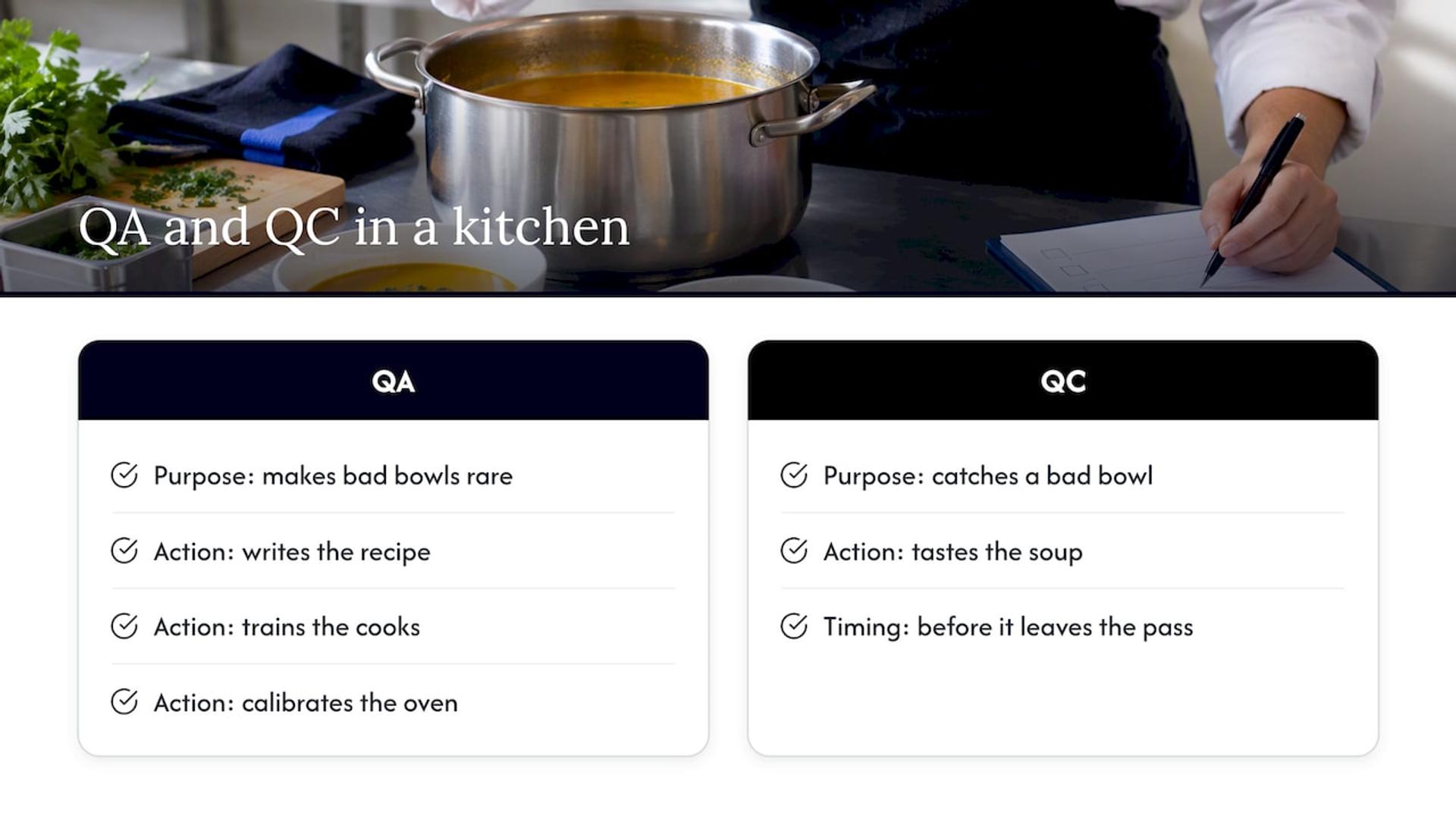
Analogy: think of a restaurant kitchen. Tasting the soup before it leaves the pass is quality control. Writing the recipe, training the cooks, calibrating the oven and checking that every station follows the same standard is quality assurance. The first catches a bad bowl. The second makes bad bowls rare.
Formal definitions say the same thing in more careful language. The Project Management Institute describes QA as support activities that give confidence that processes are established and continuously improved to produce products that meet specifications and are fit for use. ASQ frames it as planned and systematic activities within a quality system that demonstrate a product or service will fulfill quality requirements. The key words in every version are planned, systematic and confidence.
Quality assurance vs. quality control
People use the two terms as if they were interchangeable. They are not, and mixing them up is how organizations end up with a lot of inspection and no improvement.
QA is process-oriented and preventive. QC is output-oriented and detective, checking whether a product or service meets its specified requirements, as ISO’s guidance puts it. PMI adds a management angle: QA exists partly to show leadership whether repeatable processes are being used, while QC supplies project-level evidence about whether the product conforms (PMI).
| Quality assurance (QA) | Quality control (QC) | |
|---|---|---|
| Focus | The process | The product or service |
| Goal | Prevent defects | Find and remove defects |
| Timing | Before and during the work | During and after the work |
| Typical activities | Planning, standards, audits, training, metrics | Testing, inspection, reviews, verification |
| Question it answers | “Are we working the right way?” | “Did this output meet the requirement?” |
| Who benefits first | Management and the whole team | The project or release at hand |
PMI classifies testing, reviews, inspections, verification and validation as QC activities, while audits, which examine compliance with plans, policies and procedures, sit on the assurance side. In practice the two feed each other. QC findings tell QA where the process is weak. QA changes the process so QC finds less next time. ISO makes the same point: assurance provides the system in which quality control activities take place.
If the abbreviations themselves confuse you, our short piece on what QA stands for and the terms beginners mix up clears up the vocabulary.
Why quality assurance matters
Consistent processes
When the way of working is written down and followed, results stop depending on who happens to be on shift. A new hire follows the same steps as a ten-year veteran. That consistency is what customers experience as reliability.
Customer satisfaction
Customers rarely notice quality when it is present. They notice when it is missing: the wrong item, the app that crashes at checkout, the invoice with an error. QA keeps the basics boringly correct, which is where trust is built.
Risk reduction
ISO states that QA is primarily preventive: it identifies potential defects and addresses issues early, rather than correcting failures only after they occur. Problems caught early are easier and less costly to resolve. For regulated or safety-critical work, the stakes are higher. IEEE notes that its software QA planning standard is especially applicable to critical software, where failure could affect safety or cause substantial financial or social losses (IEEE 730-2014).
Continuous improvement
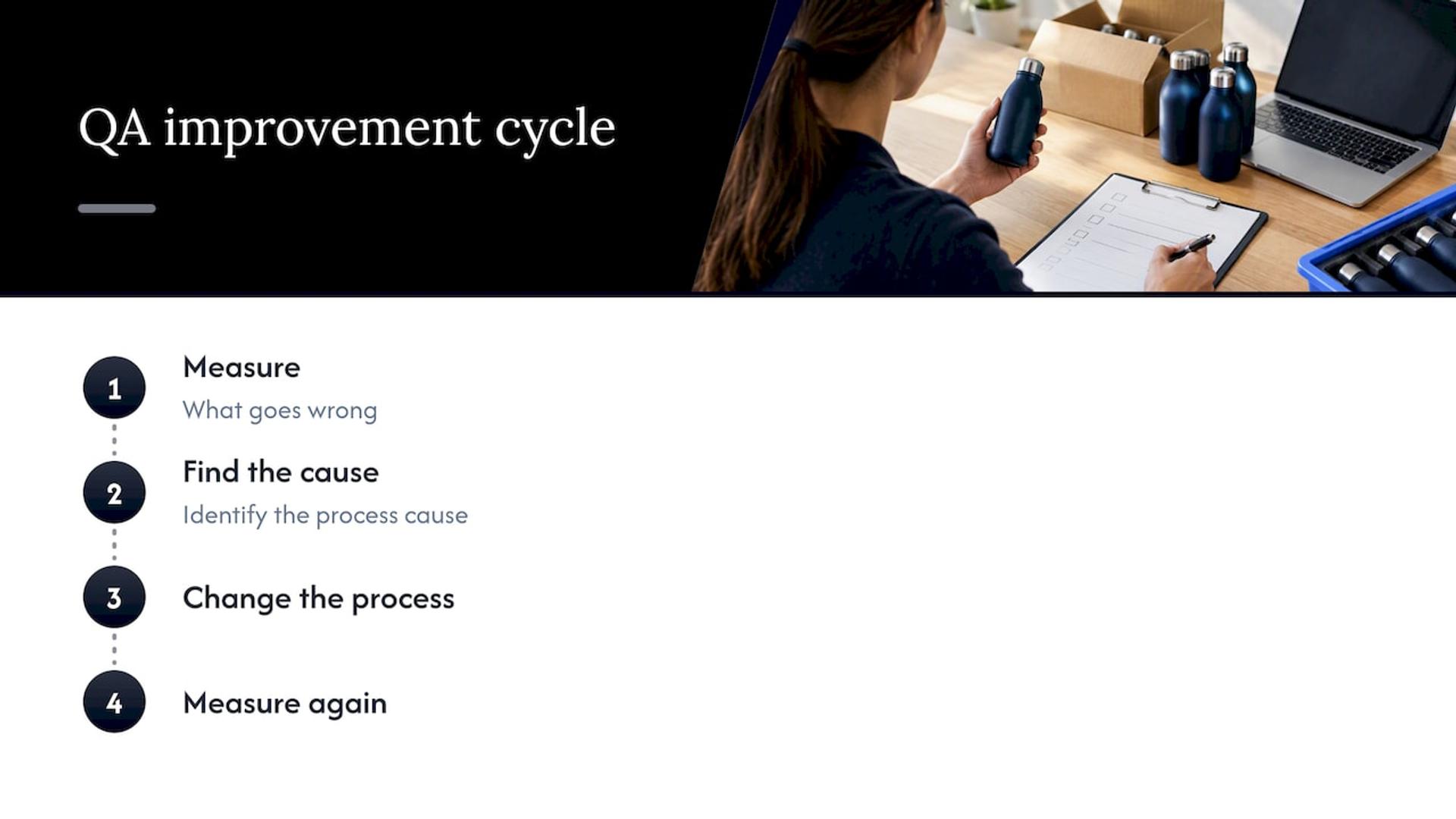
QA is not a one-time checklist. The PMI definition includes processes that are “continuously improved”, and that is the part many teams skip. Measure what goes wrong, find the process cause, change the process, and measure again.
Core quality assurance practices
The specifics vary by industry, but the same building blocks appear almost everywhere. A European Space Agency guide to software QA lists them for software projects, and they translate well beyond code:
- Quality planning. Decide what “good” means, which standards apply and who is responsible.
- Standards and procedures. Document coding standards, design standards, templates and work instructions.
- Reviews and audits. Check that plans follow standards, procedures follow plans, and products follow standards.
- Testing and verification. Run the product against its requirements. This is the QC side, planned by QA.
- Problem tracking. Log defects and nonconformances, and see them through to resolution.
- Configuration control. Know which version of what is in use, and control changes.
- Metrics. Track defect rates, rework, cycle time and audit findings.
- Training. Make sure people know the process and why it exists.
IEEE’s technical overview names a similar set for software: design reviews, code inspections, test planning, defect tracking and process audits, all integrated into the development lifecycle.
Quality assurance in software development
Software is where the QA and QC split shows up most clearly, and where teams most often confuse them. IEEE describes software QA as a process-oriented discipline that prevents defects by making sure development processes are defined, followed consistently and continuously improved (IEEE Technology Navigator). Testing is one part of it, not the whole.
What QA looks like on a software team
- Requirements are written so they can be tested, with acceptance criteria agreed before development starts.
- Code is reviewed by a second engineer against agreed standards.
- Automated tests run on every change, and a release gate blocks builds that fail.
- Defects are tracked, and recurring ones trigger a process fix, not just a patch.
- Accessibility, performance and security are treated as requirements, not afterthoughts.
Defining quality explicitly matters. ISO’s product quality model in ISO/IEC 25010:2023 breaks software quality into nine characteristics that can be specified, measured and evaluated across a product’s lifecycle. The idea is that quality should be translated into concrete measures rather than left as a general impression. Teams that want to see how quality models, requirements and acceptance criteria connect in a data-heavy setting can read this walkthrough of software quality models and testing objectives.
One caution from ISO: failures found in testing are an external measure of quality, but test failures and underlying faults are not always the same thing, because testing may not reveal every fault. That is exactly why process-level assurance matters. You cannot test your way to quality alone.
Standards worth knowing
If you work in or buy software, a few standards frame the field:
- IEEE 730-2026 sets requirements for initiating, planning, controlling and executing software QA processes in development and maintenance. IEEE published it on August 21, 2026, superseding the 2014 edition.
- ISO/IEC 25040:2024 provides a framework for evaluating software, data and IT services, and applies to developers, QA groups, acquirers and independent evaluators.
- ISO/IEC 25010 supports requirements definition, design objectives, testing objectives and acceptance criteria.
You do not need to certify against any of these to benefit. Read them as a menu of proven practices, and adopt what fits your risk level. For regulated products such as medical software, the bar is higher, and our practical FDA software validation guide covers what that looks like.
Quality assurance across industries
The vocabulary changes. The logic does not.
| Industry | QA in practice | Example |
|---|---|---|
| Manufacturing | Process standards, supplier qualification, calibration, statistical process control | A documented assembly procedure with audits of each line, plus end-of-line inspection (QC) |
| Software | Coding standards, code review, test strategy, release gates | A pipeline that blocks deployment when automated tests fail |
| Healthcare | Clinical protocols, documentation standards, validation of systems | Verifying that a patient-records system behaves as specified before go-live |
| Financial services | Control frameworks, change management, reconciliation procedures | Two-person review of any change to payment logic |
| Business operations | Standard operating procedures, checklists, customer-service scoring | Reviewing a sample of support tickets against a rubric and coaching to it |
| Education | Curriculum standards, assessment review | Peer review of course material and exam items |
QA in business operations
You do not need a factory or a codebase to practice QA. Consider invoicing. Without QA, someone catches errors when a customer complains. With QA, there is a documented invoicing procedure, a checklist, a second-person review for amounts above a threshold, a monthly count of corrections, and a conversation about why the top three errors keep occurring. The same pattern fits onboarding, proposals, hiring and support.
QA when you buy, not just build
Assurance also applies to vendors. If you outsource software, ask how quality is planned, tested and reported before you sign. Our vendor evaluation scorecard turns that into a repeatable checklist.
How to improve quality assurance in your organization
You can begin without new tools or headcount.
- Define quality in measurable terms. For each product or service, write down three to five requirements a customer would recognize: accuracy, turnaround time, uptime, error rate.
- Map the process. Draw the steps from request to delivery. Mark where mistakes have occurred before.
- Write the standard. Turn the best-known way of doing each step into a short checklist or procedure. One page beats a forty-page manual nobody opens.
- Build in checks at the points of highest risk. Peer reviews, approval steps and automated tests belong where an error is expensive.
- Audit for adherence. Once a month, sample recent work and ask whether the process was followed, not just whether the output was fine.
- Track a few metrics. Defect rate, rework hours, customer complaints and time to fix are enough to start.
- Run root-cause reviews. When something slips through, ask which process step failed and change it.
- Train and repeat. Share changes, onboard new people to the standard, and revisit it on a schedule.
If your team ships software and wants to automate step four, start with our guide on what to test first in QA automation.
Common mistakes
- Treating QA as the testing phase at the end. By then, defects are already built in.
- Measuring everything. Pick metrics you will act on.
- Blaming individuals. A repeated mistake is usually a process problem.
- Documenting without checking. A procedure nobody audits is a suggestion.
Our perspective: quality is cheaper to build than to repair
We work with healthcare, fintech, marketplace and ed-tech teams, and the pattern we see is consistent: the projects that struggle are rarely short on testing at the end. They are short on agreement at the start. Nobody wrote down what “done” means, so every release becomes a negotiation.
Our view is that QA belongs in the first conversation, not the last sprint. We put senior engineers on every project because judging risk, spotting a weak requirement and designing a release gate are senior skills. Automated tests catch regressions, but someone experienced has to decide what deserves a test, what can fail safely and what can never fail.
We also think QA should be visible to the client. If you cannot see the plan, the checks and the results, you are taking quality on faith. Ask for all three from any team you hire, including ours.
— Usama
Where Bitrupt fits
If you are building or maintaining a product and want quality designed in, our quality engineering service covers automated testing, end-to-end checks and release gates, and works alongside your own team or as part of a full build. To talk through your situation, start at bitrupt.co.
Frequently asked questions
What is the role of QA?
The role of QA is to make sure the way work is done will reliably produce the required quality. That means planning quality activities, defining standards and procedures, auditing adherence, training people and measuring results. In software, QA staff perform checks and report results while project management organizes roles and allocates staff, per the ESA guide.
Is testing the same as quality assurance?
No. Testing runs the system and compares actual results with expected ones, which PMI classifies as quality control. QA is broader: it sets expectations, plans the strategy and checks that the process is followed. Testing is one of the tools QA relies on.
Can a small business use quality assurance?
Yes, and it is often easiest there. A one-page checklist, a second pair of eyes on important work and a monthly look at recurring errors is real quality assurance. Formal certification is optional and depends on your customers and industry.
What is quality assurance in healthcare?
It is the same preventive approach applied to care and the systems behind it: clinical protocols, documentation standards and validated software, with regular review of outcomes. Specific requirements depend on the setting and regulator, so confirm them with your compliance officer or the relevant agency.
Conclusion
Quality assurance is the habit of designing work so that good results are the default. Quality control tells you whether this batch is good. Assurance tells you why the next one will be too. Start with a clear definition of quality, a written process and a regular check, then improve what the data shows.
Sources
- ISO: Quality assurance
- PMI: Practical quality management for project managers
- ASQ: Quality assurance vs. quality control
- ESA: Guide to software quality assurance
- IEEE Technology Navigator: Software quality
- IEEE Technology Navigator: Quality assurance
- IEEE 730-2014
- IEEE 730-2026
- ISO/IEC 25010:2023
- ISO/IEC 25040:2024
- Software quality models and testing objectives