How to Develop IoT Applications: Stages and 10 Checks
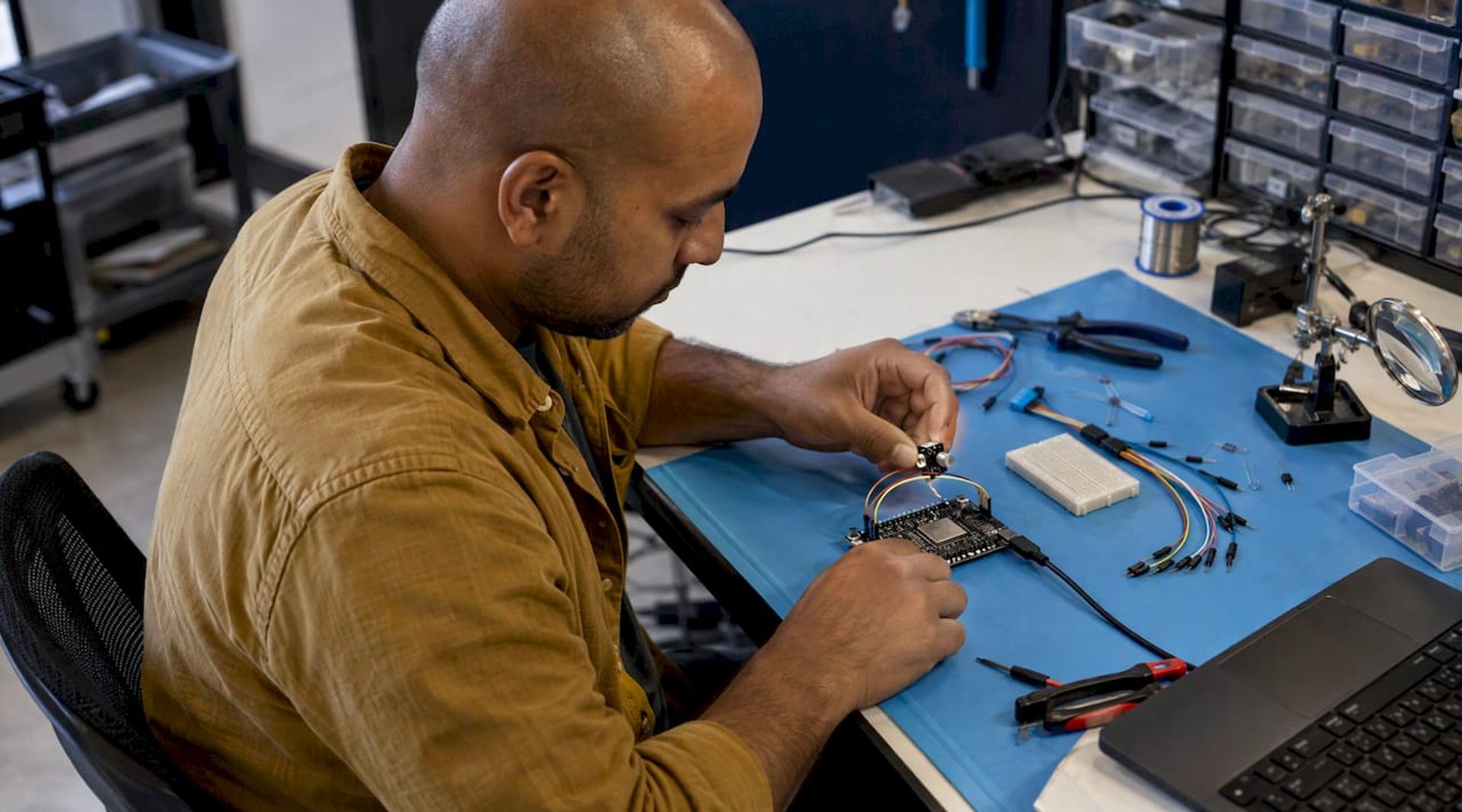
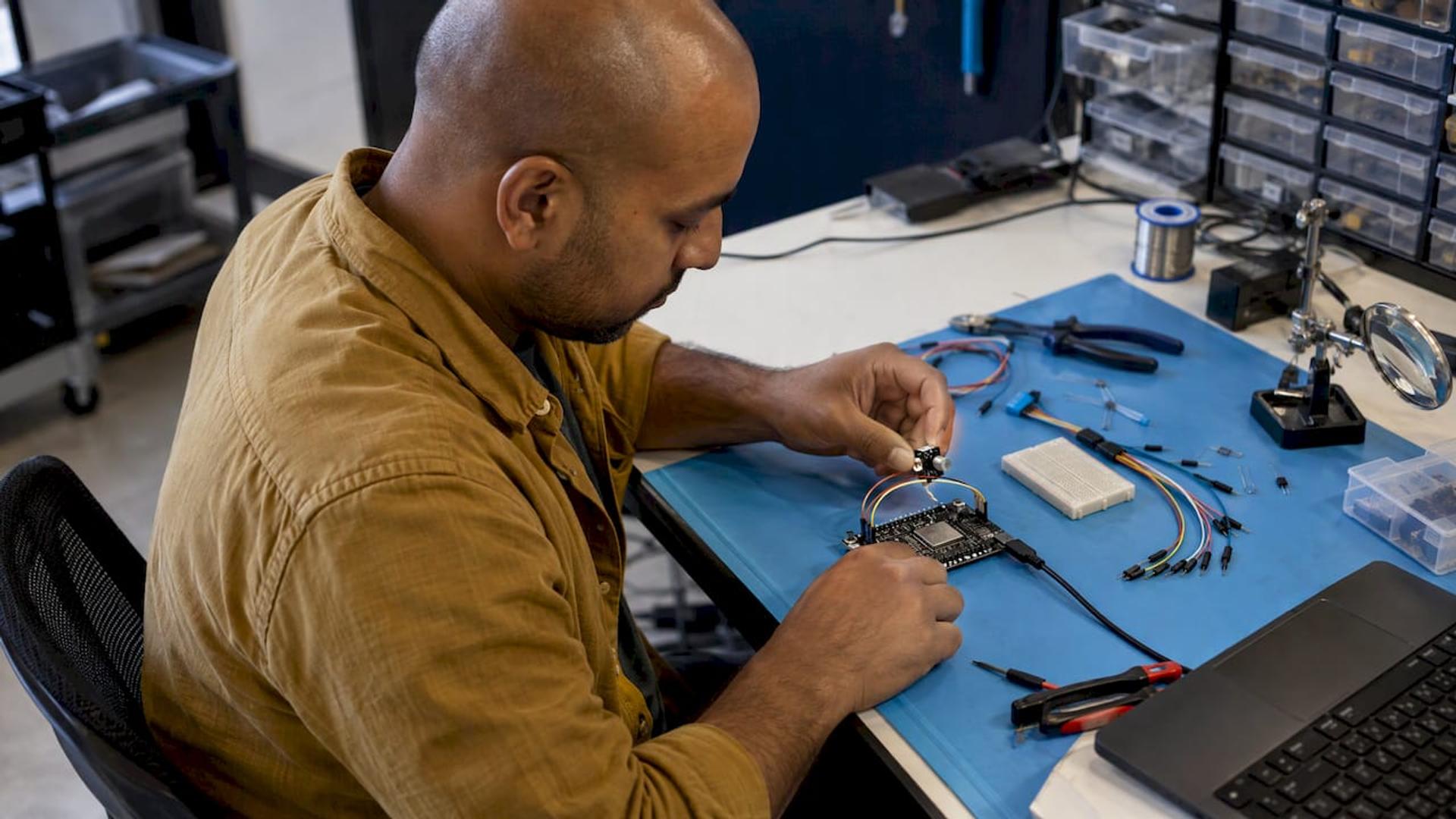
How to Develop IoT Applications: Stages and 10 Checks ! Engineer testing a sensor on a development board If you want to know how to develop IoT applications, start with the problem, not the hardware.
If you want to know how to develop IoT applications, start with the problem, not the hardware. Work in this order: define the problem and the decision the data will drive, prototype on off-the-shelf hardware, pick connectivity to match the environment, build the device, cloud and user layers, test the whole chain, then plan updates and retirement before launch. Teams that skip the early steps usually discover the gap after devices ship, when fixing it means a truck roll or a recall.
This guide walks through each stage, then gives you ten considerations to settle before you commit budget. It is written for developers, startup founders and business decision-makers who need the same map.
BitruptBuild an IoT Platform That ScalesBitrupt builds custom software for tailored, high-performance platforms, with senior engineers and end-to-end development for complex applications.Explore Bitrupt
TL;DR
- An IoT application is more than an app: it is devices, connectivity, a cloud backend and a user interface that have to work as one system.
- Define the problem and the action the data should trigger before you choose a sensor, board or platform.
- Prototype cheaply, choose protocols for your power and network limits, and test the full chain, not each part alone.
- Security, updates and decommissioning are design decisions, not launch-week tasks.
- Settle ten questions (listed below) before you build, and you avoid most expensive rework.
Table of Contents
- What an IoT application actually is
- The stages of IoT application development
- Ten considerations before you start
- Security is a design decision
- Our perspective
- Build your IoT application with a senior team
- FAQ
- Sources
What an IoT application actually is
AWS describes an IoT application as a collection of services and software that takes in data from IoT devices, analyzes it with machine learning or AI, and sends decisions back to the devices so they respond intelligently. In plain terms: sensors observe, software decides, something acts.
NIST’s model of IoT systems breaks them into five primitives: sensor, aggregator, communication channel, external utility and decision trigger. That vocabulary is handy when you sketch your own system, because it forces you to name where each piece lives.
Analogy: think of a smart thermostat. The temperature sensor is the nerve ending, the home Wi-Fi is the spinal cord, the cloud service is the brain, and the heating relay is the muscle. If one link is slow, drops out or is spoofed, the whole body misbehaves.
One more point from NIST: an IoT product usually needs more than the device itself, such as a cloud backend or a companion app on a phone or computer. Budget and plan for all of it from day one. For a broader look at the pieces, see our guide to the building blocks of IoT software.
The stages of IoT application development
Stage 1: Identify the problem and the decision
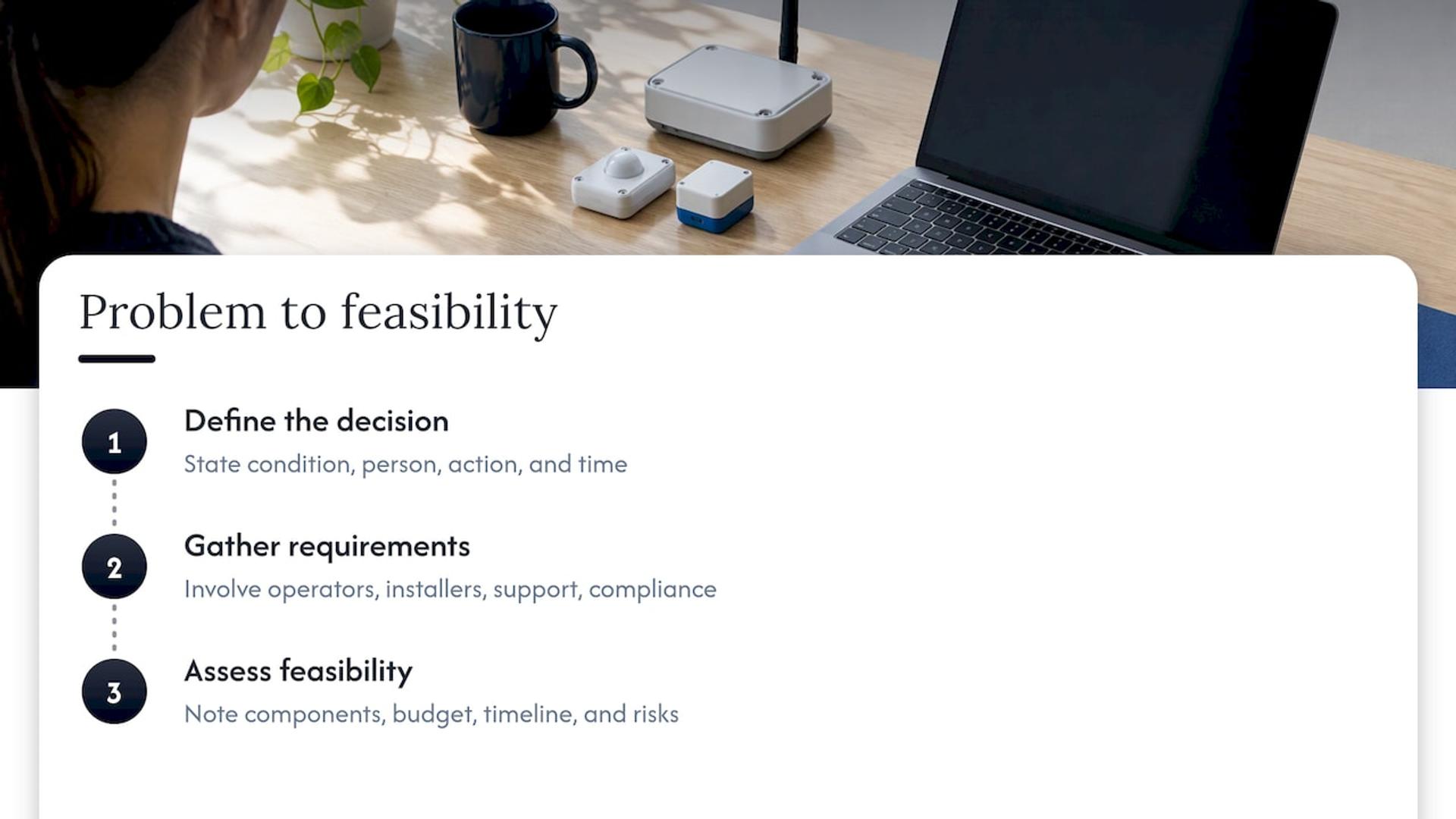
Write one sentence: “When [condition] happens, [person or system] should do [action] within [time].” A cold-chain operator might write: when a pharmacy shipment rises above its temperature limit, the dispatcher is alerted within two minutes. That sentence tells you what to sense, how often, how fast the network must be, and who sees the alert.
Then list requirements with the people who will live with the system: operators, installers, support staff, compliance owners. Requirements work in IoT is notoriously tricky because the stakeholders span hardware, software and operations. Academic work on requirements engineering for IoT stresses capturing, modelling, verifying and validating stakeholder needs, with prioritization done together with those stakeholders.
Finish this stage with a short feasibility note: components, rough budget, timeline, and the risks you cannot yet answer. If you want to see what problems are worth solving, our list of IoT device examples that cut cost and downtime shows how businesses frame them.
Stage 2: Prototype with off-the-shelf hardware
Build the ugliest working version you can. A development board, a few sensors and a phone hotspot will prove whether the signal you care about is actually measurable. Many teams find that the sensor they assumed would work drifts, saturates or misses events in the real environment.
Keep the prototype honest: run it where it will live, not on a desk. A soil-moisture probe behaves differently in clay than in a demo pot, and a vibration sensor on a motor housing tells a different story than one taped to a table.
Prototype goals:
- Confirm the sensor produces data good enough to drive the decision.
- Measure real power draw so you can size batteries or supplies.
- Observe connectivity in the real site, including dead zones.
- Show a rough dashboard to a real user and watch what they ask for.
Stage 3: Select hardware and sensors
Choose hardware around constraints, not specs on a datasheet:
- Power: mains, battery or energy harvesting? A battery device that must last years limits your radio, sampling rate and processor.
- Environment: heat, moisture, dust, vibration, electromagnetic noise.
- Compute location: what runs on the device (filtering, simple rules) versus in the cloud (analytics, models).
- Supply chain: can you buy the part in volume in two years? Is there a second source?
- Certification: radios generally need regulatory approval before sale, so involve a test lab early rather than after the board design is frozen.
For factory and industrial sites, NIST’s guide to industrial wireless deployments gives engineers and managers checklists for defining objectives, studying the deployment environment, and then selecting, deploying and monitoring wireless systems.
Stage 4: Choose connectivity and protocols
The network decision comes down to range, bandwidth, power and cost per device.
| Option | Best for | Trade-off to plan around |
|---|---|---|
| Wi-Fi | Homes, offices, powered devices | Higher power draw, depends on local network |
| Bluetooth Low Energy | Wearables, short-range pairing, phone-connected devices | Short range, needs a gateway or phone |
| Cellular (LTE-M, NB-IoT) | Mobile or remote assets | Data plans and carrier coverage |
| Low-power wide-area radio | Sparse sensors sending small payloads | Low bandwidth, limited downlink |
| Ethernet | Fixed industrial equipment | Cabling cost |
On top of the radio sits the messaging protocol. MQTT is an OASIS standard: a lightweight publish/subscribe messaging protocol designed for constrained devices and for low-bandwidth, high-latency or unreliable networks. That makes it a common default for telemetry. HTTP and REST remain fine for devices that talk occasionally and have power to spare, while protocols such as CoAP suit very small devices. Pick one, document why, and keep payload formats versioned so devices of different ages can coexist.
Stage 5: Design the architecture and build the software
A typical IoT application has four software layers:
- Firmware: reads sensors, handles local rules, buffers data when the network drops, and accepts signed updates.
- Ingestion: a broker or cloud IoT service that authenticates devices and receives messages.
- Data and logic: storage for time-series data, a rules engine, and any analytics or machine learning.
- Experience: web or mobile apps, alerts, and APIs for other systems.
NIST’s CPS and IoT foundations work organizes system analysis into facets (conceptualization, realization, assurance) and aspects such as trustworthiness, timing and data. You do not need to adopt the whole framework, but running your design past those aspects is a good way to spot gaps.
Analogy: building the firmware without the cloud design is like laying plumbing before you know where the bathrooms go. It works until you need to move something.
If AI is part of your plan, keep latency in mind. TechTarget’s Tom Nolle notes that AI should not add delay to a control loop that needs real-time response. Decisions that need milliseconds belong near the device; trend analysis and anomaly detection can live in the cloud.
The user layer deserves real design time. Installers, technicians and end users all touch the system, and each needs a different view. Our product design and UX team works on exactly that gap between raw telemetry and a screen people can act on.
Stage 6: Integrate sensors, cloud and third-party systems
Integration is where projects stall. Calibrate sensors, agree on units and timestamps (use UTC everywhere), and decide how a device proves its identity to the cloud. Then connect the output to the systems people already use: a maintenance ticketing tool, an ERP, an electronic health record, a payments service.
When choosing a cloud platform, compare device provisioning, message throughput limits, rules and routing, data retention, and how updates are pushed. If your team is leaning toward one of the major clouds, our cloud application development services cover AWS and GCP builds.
Stage 7: Test the whole chain
Test in layers, then end to end:
- Unit and integration tests for firmware logic, APIs and message handling.
- End-to-end tests from sensor event to user alert, with timing measured.
- Performance and load tests with simulated devices at ten or a hundred times your launch count.
- Security testing: credential handling, update signing, exposed ports, API authorization.
- Field tests with bad networks, power cuts, and devices rebooting at the worst moment.
Hardware adds stages that pure software does not. A common product path runs from prototype through engineering validation, design validation and production validation to mass production, as Memfault describes. Each gate exists to catch a different class of problem before it is multiplied by thousands of units.
Stage 8: Deploy, monitor and maintain
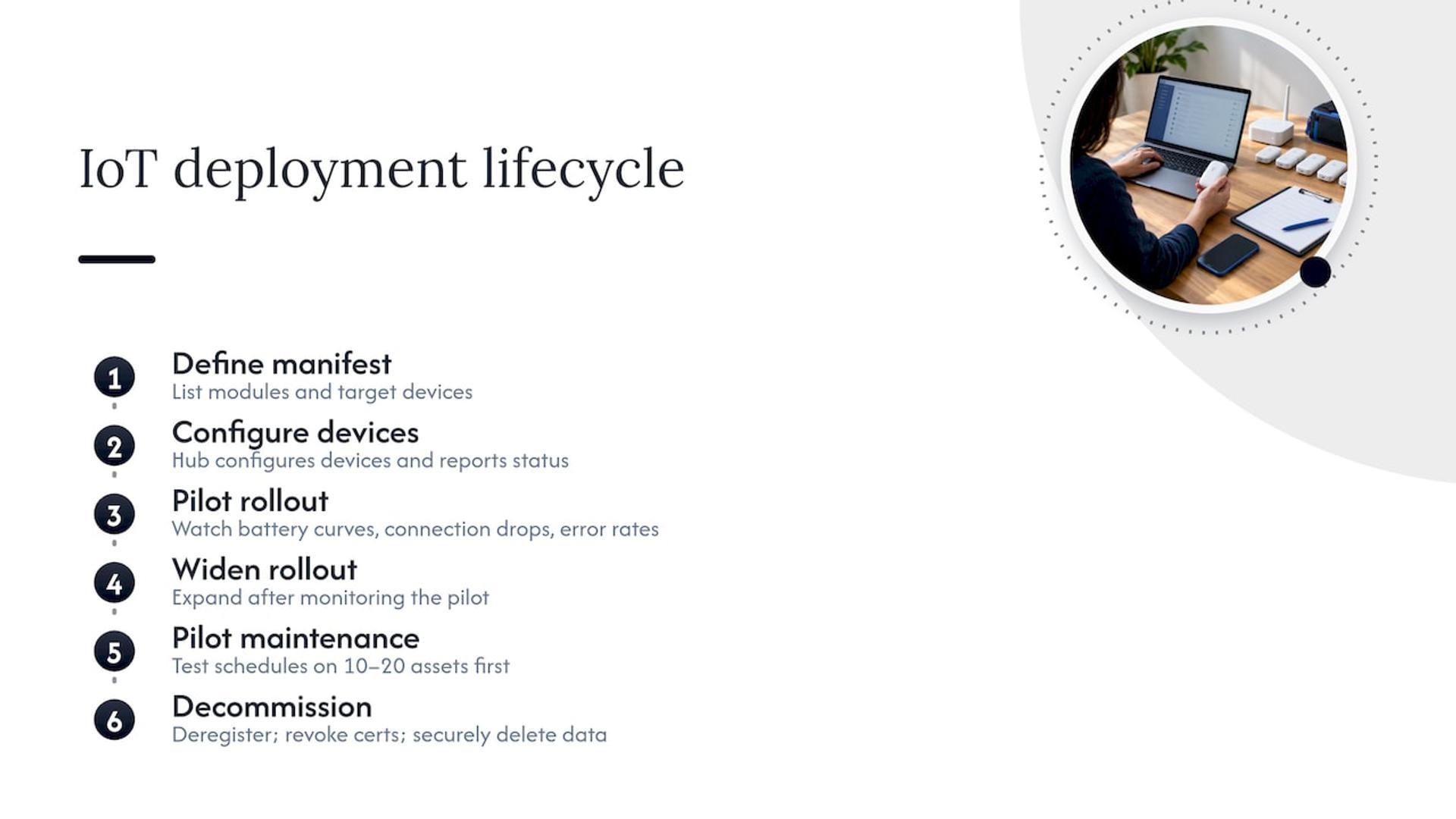
Roll out in waves. Start with a pilot group, watch battery curves, connection drops and error rates, then widen. Microsoft’s documentation on IoT Edge deployments shows the pattern: define a deployment manifest listing modules and target devices, and let the hub configure devices and report status back.
Small operations teams in particular benefit from starting small. One practical approach is to pilot device maintenance schedules on 10 to 20 assets before scaling the routine to the whole fleet.
Maintenance also includes the end of a device’s life. Decommissioning should mean deregistering the device from the management platform where applicable, revoking its security certificates and securely deleting confidential data, in line with NHS England Digital guidance cited alongside Microsoft’s documentation. Build those functions in at the start; they are painful to retrofit.
Ten considerations before you start
Use this as a gate review. If you cannot answer one, that is your next task.
- The problem and the action. Can you state what the data will trigger and who benefits?
- Security. Who can talk to a device, how are identities issued, and how are updates verified? More on this below.
- Scalability. What happens at 10 devices, 1,000, 100,000? Message volume, database growth and support load each scale differently.
- Data management. What do you collect, how long do you keep it, who owns it, and what rules apply (health, financial or personal data each bring obligations)? Our AI data governance playbook is a useful framework if models will use the data.
- Costs. Count the whole lifecycle: hardware, certification, connectivity plans per device, cloud usage, app development, support and replacement. Recurring costs usually exceed build costs over time. If AI features are planned, our AI development cost calculator gives a starting range.
- Device compatibility. Which phones, gateways, operating systems and existing equipment must it work with? Decide on open standards over proprietary links where you can.
- Connectivity reality. Test where devices will actually sit. Plan offline behavior: buffer locally, send later, never lose critical events.
- Power and hardware lifespan. Battery replacement in the field can cost more than the device. Size for the real duty cycle.
- Maintenance and updates. Can you push firmware over the air safely, roll back a bad release, and see which devices are on which version?
- Team and partners. Do you have firmware, cloud, mobile and security skills in the same room? Gaps here cause more delays than technology does.
Security is a design decision
Security cannot be a final pass. NIST’s cybersecurity handbook for product developers describes concepts for secure IoT products across architecture, deployment and roles, and extends NISTIR 8259. NIST also publishes the NISTIR 8259 family, including the core baseline of technical device capabilities that support common cybersecurity controls.
Practical defaults that follow from that guidance:
- Give every device a unique identity and credentials. Never ship a shared default password.
- Encrypt data in transit, and protect keys in secure hardware where the chip supports it.
- Sign firmware and verify signatures before installing.
- Limit what each device can send and receive to the minimum it needs.
- Log device and admin activity so you can investigate odd behavior.
If your devices sit in plants or utilities, it helps to see how industrial IoT threats map to the IEC 62443 standards. For layered defenses in general, read our piece on IoT security layers and practical defenses.
Our perspective
We have seen IoT projects fail for one reason more than any other: the team treated the device as the product. The device is the doorway. The product is what happens after the data arrives, and that is software.
Analogy: a sensor with no good application behind it is a smoke detector with no alarm. It notices everything and tells no one.
That is why we work with senior engineers only. IoT crosses firmware, cloud, mobile and security, and the expensive mistakes happen at the seams between them. Someone who has shipped before will question the protocol choice, the update path and the offline behavior in week one, not month six.
Our advice: start with a narrow pilot, instrument it heavily, and let the results decide what to scale. Flexible engagement, such as a development pod or senior engineers added to your team, lets you do that without hiring a full department first.
Usama
Build your IoT application with a senior team
If you are scoping an IoT product and want engineers who work across the device, cloud and app layers, take a look at our IoT software development services. We work as a development pod or add senior engineers to your existing team, and we aim to respond within 24 hours.
For the AI layer, such as anomaly detection or predictive models on sensor data, see our AI and data engineering work, or talk to us about your project.
FAQ
How long does it take to develop an IoT application?
It depends on whether hardware is involved and how much must be certified and manufactured. A software-only pilot using existing devices is far quicker than a new device that needs validation stages and production tooling. Scope a pilot first, then estimate the full build from what the pilot teaches you.
Which programming languages are used for IoT?
Firmware is commonly written in C or C++, with some teams using Rust or MicroPython on suitable boards. Cloud services often use Node.js, Python, Go or Java, and the user layer typically uses web frameworks such as Next.js and mobile frameworks such as React Native. Choose based on your team’s skills and the device’s constraints.
Do I need my own cloud, or can I use an IoT platform?
Most teams start with a managed IoT service from a major cloud because it handles device identity, messaging and routing. You can move to a custom backend later if you need more control. Keep your message formats and device identity scheme portable so that switching stays manageable.
What is the most common reason IoT projects fail?
Unclear requirements. Research reviews of IoT requirements practice report that many applications do not systematically define functional requirements, which leads to errors that hurt user satisfaction and performance. A one-sentence problem statement and a pilot guard against this.
Sources
- What is IoT? Internet of Things Explained (AWS)
- Networks of ‘Things’ (NIST SP 800-183)
- Product Development Cybersecurity Handbook (NIST)
- REFIoT: requirements engineering for IoT
- Guide to Industrial Wireless Systems Deployments (NIST)
- MQTT FAQ (mqtt.org)
- Cyber-Physical Systems and IoT Foundations (NIST)
- AI and IoT (TechTarget)
- Insights into the IoT Product Development Process (Memfault)
- Automatic deployment for device groups (Microsoft Learn)
- NIST IoT Device Cybersecurity background
- Industrial IoT Security for OT
- Small Teams: Start Device Maintenance by Piloting 10 to 20 Assets
- A Systematic Review of Functional Requirements, Modelling Practices and Validation Strategies