SaaS Application Development: Architecture, Cost, and How to Build One
SaaS Application Development: Architecture, Cost, and How to Build One ! Engineer working on SaaS application architecture SaaS application development is the work of building software that you host and run centrally, and that customers use through a browser or API on a subscription.


SaaS application development is the work of building software that you host and run centrally, and that customers use through a browser or API on a subscription. That sounds simple until you list what it demands: one codebase serving many customers, data kept strictly apart, billing, uptime, security reviews and a release process that never stops. This guide covers the architecture, the build stages, what drives cost, and the mistakes that sink first versions. I wrote it for founders and business teams deciding how to start.
BitruptBuild a SaaS Foundation That ScalesBitrupt builds custom software with senior engineers, creating scalable, secure platforms tailored to your product and technical needs.Explore Bitrupt’s software development
TL;DR
- A SaaS application is software the provider hosts and manages; customers only use it, and usually pay by subscription or usage.
- Most SaaS products share one application instance across customers (multi-tenancy), so tenant isolation is the first architecture decision, not the last.
- Build in stages: validate the problem, scope a narrow MVP, design the foundation, build and test, launch to a small group, then maintain and iterate.
- Cost is driven by feature scope, team seniority, technology choices and the infrastructure and support you pay for every month after launch.
- The most expensive mistake is skipping analysis and rebuilding the foundation after the first enterprise customer asks hard questions.
Table of Contents
- What a SaaS application actually is
- SaaS architecture: the decisions that are hard to undo
- Security, privacy and reliability
- Technology choices: what languages are used for SaaS
- The stages of building a SaaS application
- What SaaS application development costs
- A practical example
- Common challenges and how to handle them
- Our perspective
- Build your SaaS product with Bitrupt
- FAQ
- Sources
What a SaaS application actually is
NIST defines software as a service as the capability to use a provider’s applications running on cloud infrastructure, reached from client devices through a browser or program interface. The customer does not manage the servers, operating systems, storage or network underneath. That last part is the real definition. If your customers have to install, patch or host it, it is not SaaS, however modern it looks.
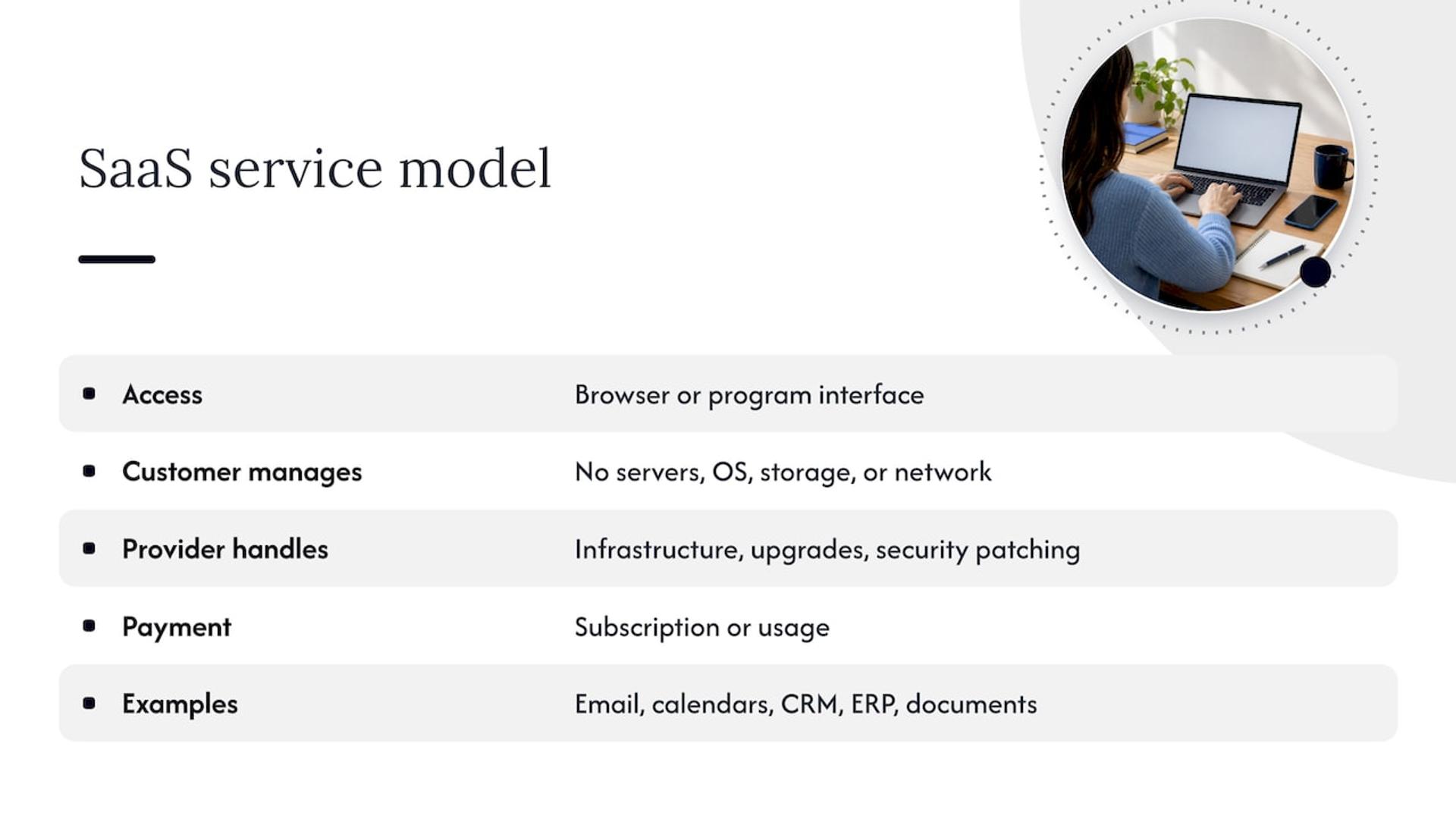
The U.S. General Services Administration lists typical examples: web email, calendaring, office and collaboration tools, CRM, ERP and document management. It also notes that the provider handles infrastructure, upgrades and security patching, and users typically pay by subscription or usage.
For you as the builder, this shifts the job. You are not shipping a product once. You are operating a service, and every customer’s experience depends on how well you run it on day 400, not just on launch day.
Analogy: selling traditional software is like selling a car. Running SaaS is like running a taxi company. The vehicle matters, but so do dispatch, fuel, insurance and keeping every car on the road.
SaaS architecture: the decisions that are hard to undo
Architecture is where SaaS application development differs most from a regular web app. A few choices shape everything that follows.
Multi-tenancy and tenant isolation
IBM describes the common pattern: one application instance serves multiple customers, while each customer’s data, configuration and user information stay segregated. Those customers are called tenants.
There are three practical ways to isolate them. AWS’s SaaS guidance calls them silo, pool and bridge. In a silo model each tenant gets its own resources. In a pool model tenants share resources. The bridge model mixes the two: for example, a shared web tier on top of a separate application tier and storage per tenant.
| Approach | How it works | Strength | Trade-off |
|---|---|---|---|
| Pooled (shared everything) | All tenants share app and database, separated by a tenant ID | Lowest cost per customer, simplest to operate at scale | Isolation bugs are serious; one noisy tenant can slow others |
| Silo (dedicated stack) | Each tenant has its own app tier and storage | Strong isolation, easy to meet strict customer demands | Higher cost, more operational work per customer |
| Bridge (hybrid) | Some layers shared, sensitive ones dedicated | Balances cost and isolation | More design effort up front |
There is no universal winner. AWS’s Well-Architected SaaS Lens stresses that tenancy, isolation and data-management decisions should follow your domain, compliance profile and target market. A tool for small agencies can pool everything. A platform holding patient or financial records may need dedicated storage for larger accounts.
Our practical advice: pick a model that lets you start pooled but move a single large customer to dedicated resources later without rewriting the app. That means putting the tenant identifier into every query, every cache key and every background job from day one.
Cloud infrastructure
Most teams build on a major cloud such as AWS or Google Cloud, with a frontend host like Vercel when the web app uses Next.js. The choice matters less than how you use it. Keep infrastructure defined as code, so a new environment is a command rather than a weekend. Automate builds and deployments with CI/CD so releases are routine. Use managed databases and queues where you can, because every server you do not run is one you do not patch.
Scalability
AWS’s SaaS architects recommend designing for growth from the start, so onboarding a new tenant does not add operational overhead. In practice that means automated tenant provisioning, per-tenant usage metrics, and limits so one customer cannot starve the rest.
Do not overbuild, though. A well-structured monolith on managed services handles a surprising amount of load. Splitting into microservices before you have the team or traffic to justify it is the software equivalent of buying a Ferrari for a farm: impressive, expensive, and wrong for the terrain.
Third-party integrations
Business customers expect your product to connect to what they already use: identity providers, payment processors, accounting tools, CRMs, email and analytics. Plan an integration layer early. Wrap each external service behind your own interface, handle retries and failures, and store credentials per tenant. When a vendor changes its API, you then fix one adapter rather than the whole product.
Single sign-on is the integration enterprise buyers ask about most. Our guide to single sign-on in a regulated healthcare setting shows how much planning an identity layer needs when the stakes are high.
Security, privacy and reliability
In SaaS you hold other companies’ data, so security is a product feature. NIST’s cloud guidance says organizations should keep accountability for their data and applications and continuously monitor security and privacy risks. Your customers apply that same standard to you, and their security questionnaires will test it.
Cisco lists the trade-offs customers accept with SaaS: less control over the application and infrastructure, data security and privacy concerns, latency effects and outages. Each one is a promise you have to keep on their behalf.
A working baseline for a new product:
- Tenant isolation tests. Automated tests that try to read one tenant’s data as another, run on every release.
- Encryption and secrets handling. Encrypt data in transit and at rest, and keep keys out of code.
- Role-based access. Admin, member and read-only roles from the first version.
- Audit logs. A record of who did what, which enterprise buyers routinely request.
- Backups you have restored. A backup you have never tested is a hope, not a plan.
- Monitoring and alerting. Know about an outage before your customers email you.
If your product touches health or financial data, involve a compliance specialist before design is final. Rules such as HIPAA for health information depend on your exact use case, and a qualified attorney or compliance advisor should confirm what applies to you. Our team’s work in multi-tenant, SSO-ready SaaS and regulated sectors starts from that conversation.
Technology choices: what languages are used for SaaS
People ask what programming language SaaS is written in. The honest answer is that many work. Mainstream choices include TypeScript with Node.js and React or Next.js for web products, Python for data-heavy and AI features, and Java, C# or Go for high-throughput back ends. Developer surveys show Python gaining on the back of AI work, and PostgreSQL remaining a leading database choice.
How to choose:
- Hire for it. Pick a stack your team, or your hiring market, knows well.
- Favor boring and proven. A relational database such as PostgreSQL handles most SaaS data models, including per-tenant separation.
- Match the stack to the product. An AI-driven product often wants Python services alongside a TypeScript web app.
- Avoid lock-in you do not need. Managed services save time, but keep your core business logic portable.
The stack rarely decides whether a SaaS succeeds. Clear scope, solid tenancy design and disciplined releases matter far more.
The stages of building a SaaS application
Stripe’s guide to starting a SaaS business recommends identifying a real customer problem, starting with a focused MVP, designing a secure multi-user foundation, testing iteratively and using a beta or staged launch. That matches how we run builds. Here is the sequence in practical terms.
1. Validate the idea
Talk to ten to twenty people who have the problem. Ask what they use today, what it costs them and what they have already tried to fix. The strongest signal is not enthusiasm, it is someone offering to pay, pilot or share real data. Check that buyers can actually pay: who holds the budget, and how long does their approval take?
2. Plan and scope
Write down the one workflow your product must do better than anything else, and cut the rest. List features as must-have, later and never. Decide your pricing model early (per seat, per usage or tiered), because it shapes your data model and your billing code.
3. Design the experience and the architecture
Product design and architecture happen together. Clickable prototypes expose confusing flows before they become expensive code. At the same time, settle tenancy, authentication, data model and integration points. This is the stage people skip, and it is the one that costs the most later.
Analogy: skipping analysis is like baking a cake without a recipe. You may get something edible, but you cannot repeat it, and you cannot scale it for a wedding.
4. Build in short cycles
Ship working slices every one to two weeks: sign-up and tenant creation first, then the core workflow, then billing. Each cycle ends with something a real user can try. Senior engineers pay off here, because the early decisions in code structure are the ones that compound.
5. Test beyond the happy path
Automated tests cover the core workflow and tenant isolation. Exploratory testing finds what scripts miss. Accessibility checks matter because many business and public-sector buyers require them. Load-test before launch, not after the first big customer onboards.
6. Deploy and launch in stages
Start with a closed beta of friendly customers, watch the logs and support requests, then widen access. Use feature flags so you can switch off a risky feature without a redeploy, and rehearse rollback.
7. Maintain and improve
Launch is the start of the cost curve, not the end. You will patch dependencies, answer security questionnaires, tune performance, add integrations and ship what customers ask for. Plan for it with a retained team or an ongoing support agreement, not as an afterthought.
What SaaS application development costs
There is no honest single number, because scope varies enormously. A narrow MVP for one workflow is a different project from a platform with enterprise SSO, custom reporting and a dozen integrations. Our own guide to what an app costs for founders frames typical ranges from $10,000 to $150,000, and our custom software cost guide explains how to budget beyond a headline quote. For AI features, the AI cost calculator gives a starting estimate.
The main drivers:
- Feature scope. Every role, report and integration adds design, build and test time. Authentication, billing, admin tools and notifications are features too, and they are easy to forget when you sketch the product.
- Team size and seniority. A small senior team often finishes faster than a larger mixed one, since less work is redone and decisions are made quickly. Rates differ by experience and location; compare total delivered cost, not hourly price alone.
- Technology choices. Managed services and mature frameworks reduce build time. Custom infrastructure, real-time features, heavy data processing or AI models raise it.
- Compliance. Audits, penetration testing and security documentation add real cost, especially in healthcare and finance.
- Infrastructure. Hosting, databases, monitoring, email, error tracking and third-party API fees recur every month and grow with usage. Model them per tenant so you know your margin before you set a price.
- Maintenance and support. Budget a recurring share of the build cost every year for fixes, upgrades and enhancements. Skipping it turns into technical debt that is much dearer to repay.
- Getting customers. Building is only half the spend. Organic channels can lower the cost of acquiring SaaS customers, which matters when you plan runway.
Hidden costs usually come from what was not scoped. Before you sign any estimate, ask what is excluded: migrations, admin tooling, security review, app store fees, post-launch support. The same thinking applies to any large platform; our piece on budgeting total cost of ownership for cloud ERP shows the habit of itemizing every bucket, and it carries over to SaaS.
A practical example
Imagine a startup building scheduling software for physical therapy clinics. The first version covers appointments, reminders and a simple intake form. Each clinic is a tenant. The team starts with a pooled database, a tenant ID on every record and role-based access for front desk and clinicians.
Six months in, a hospital group wants to buy for 40 locations. Their security team asks about data separation, audit logs and SSO. Because tenant IDs, logging and an identity layer were designed in, the startup can offer a dedicated database for that customer and connect their identity provider in weeks. Without that groundwork, the same request would mean a rewrite and a lost deal.
The lesson: build the first release small, but build the foundations as if a demanding customer is coming. One will.
Common challenges and how to handle them
- Scope creep. Every early customer wants something custom. Keep a public roadmap, say no to one-off features, and make the product configurable instead.
- Retrofitting multi-tenancy. Adding tenant separation after launch touches every table and query. Do it first.
- Weak onboarding. If users do not reach value in their first session, churn follows. Treat onboarding as a product feature with its own metrics.
- Underpriced infrastructure. A heavy customer on a flat plan can erase your margin. Track usage per tenant and set limits.
- Single points of failure. One engineer who knows the deployment process is a risk. Document it and automate it.
- Security as a last step. Questionnaires arrive with the first serious buyer. Build logging, access control and encryption in from the start.
- Building in a vacuum. Release to a small group early. A rough product in front of real users teaches more than months of polish.
Our perspective
We have seen the same pattern across healthcare, fintech, marketplace and ed-tech builds: teams rarely fail because the code is bad. They fail because the first three weeks of thinking were skipped. Analysis is insurance. It costs a little up front and saves you from paying twice when requirements, compliance or scale catch up.
That is why we staff projects with senior engineers only, and why you talk directly to the people making technical decisions. A senior engineer asks the uncomfortable question about tenancy or data retention in week one, when the answer is a whiteboard sketch rather than a migration. If you are weighing a build, start with the smallest version that proves someone will pay, and put your effort into the foundation underneath it. I am happy to help you think it through.
— Usama
Build your SaaS product with Bitrupt
If you are planning a SaaS product, we can help at any stage: scoping the MVP, designing a multi-tenant architecture, building the web and mobile apps, adding AI features and running the product after launch. You can work with us through a dedicated development pod or add senior engineers to your own team.
See how we approach SaaS and B2B software development, or explore our web platform services if you already know what you need.
FAQ
What does SaaS application mean?
A SaaS application is software that a provider hosts and manages on cloud infrastructure, and that customers use through a browser or API. Customers do not install or maintain it, and they usually pay by subscription or usage. The provider handles hosting, updates and security patching.
How do you create a SaaS application?
Start by validating a real customer problem, then build a focused MVP on a secure multi-tenant foundation. Test it with a small beta group, set up pricing and payments, and launch in stages. After launch, plan ongoing maintenance and regular releases.
What is an example of a SaaS app?
Common categories include web email, calendaring, office and collaboration suites, CRM, ERP and document management. In each case the provider runs the software and customers access it online. Smaller vertical products, such as scheduling software for clinics, work the same way.
How long does SaaS application development take?
It depends on scope. A focused MVP is often built in a matter of months, while a platform with enterprise features, compliance work and many integrations takes longer. Cutting scope to one core workflow is the most reliable way to shorten the first release.
Sources
- Software as a Service (SaaS) - NIST CSRC Glossary
- Software as a Service (SaaS) - GSA Cloud Information Center
- What Is Software as a Service (SaaS)? - IBM
- The bridge model - AWS SaaS Lens
- SaaS Lens - AWS Well-Architected Framework
- NIST SP 800-144, Guidelines on Security and Privacy in Public Cloud Computing
- What Is SaaS? - Cisco
- How to start a SaaS business: A guide - Stripe
- Why brands should use SaaS SEO